
Article written by Ainsley Hall and published in The Journal on October 8, 2026, link to full article HERE.
Berkeley County Schools invited parents and guardians to attend a free Internet Safety event at Spring Mills High School on Oct. 6 where they heard from Homeland Security Investigations (HSI) on how to keep their kids safe online. Through the presentation guests learned more about the threats children face, how to better protect them and how to respond.
The event started with Kristen Donat, prevention education specialist and outreach coordinator at the Eastern Panhandle Empowerment Center (EPEC). After watching a webinar with HSI, Donat knew she had to bring them to Berkeley County. She believed the community needed to hear what they had to say, but she couldn’t find the right opportunity. That was until Berkeley County Schools reached out to her about putting together an event for parents. Donat invited other organizations to participate in a resource fair so parents can get information while also hearing from HSI.
“I’m super grateful that HSI came,” Donat said. “It’s a topic that’s not talked about enough. I think for Millennials and young parents, they grew up with the internet, so they think it’s safe, but they don’t realize how much it’s evolved.”
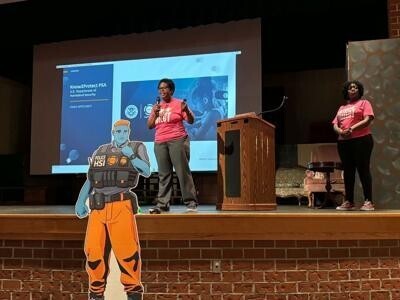
HSI Forensic Interview Specialist Traci Owusu and Victim Assistance Specialist Kyanna Perkins led the presentation. They shared information on the Department of Homeland Security’s Know2Protect Campaign, a national public awareness campaign meant to educate and empower people to prevent online child sexual exploitation. By teaching kids, parents, teachers and other people in the community about the threats, they can better protect children and prevent this from happening to others.
In 2025 alone, they reported having 21.3 million reports and 61.8 million files or photos that were found by investigators. Out of those numbers, 1.5 million involved AI and 1.4 million involved online enticement. Many of these threats start on social media or online games until they move to chat rooms. Perkins explained that though they started their work in high schools, over the years the kids impacted have become younger and younger and they now visit elementary schools to have age-appropriate presentations to warn kids of the dangers. Their goal is to give kids a safe place they can trust where they can report what they’ve experienced.
However, knowing the threat is just the first step. Parents and guardians need to be aware and watch for changes in behavior in their kids such as withdrawing from real world friends, receiving random gifts from strangers and vague questions and answers regarding online behavior. Owusu recommended setting social media accounts to private and making sure location settings on devices are turned off. However, if something does happen to their child, Owusu tells parents to stay calm.
“It’s very hard for children to even come forward to talk about something like that, just because of how they’re feeling,” Owusu said during the presentation. “And a lot of times when we do talk to our young people, they say that they could never tell their parents because they know their parents are going to be so mad, they’re going to flip out on them. So, try to be calm, create a caring environment where your child feels safe to talk to you and make sure that communication stops with the offender, blocking the account, saving the evidence, but contacting the authorities about the platform.”
For more information about online safety, visit https://www.dhs.gov/know2protect.