Article written by Ainsley Hall and published in The Journal on October 13, 2026, link to article HERE.
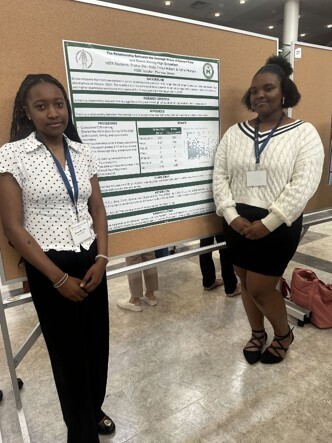
Four Berkeley County students attended the West Virginia University Van Liere Conference on Oct. 3 to present their research projects as part of the Health Sciences & Technology Academy (HSTA) program. Together with HSTA Field Site Coordinator for the Eastern Panhandle Aaron Ruffner, the students learned from professionals in the field and learned more about higher education.
HSTA is a mentoring program in West Virginia that’s designed to help students from low-income families pursue a degree in those fields. They attend after school meetings, complete research projects, do community service, maintain a high GPA average and more. Musselman High School seniors Ennya Wilson and Trishia Ofori-Yesu have been members of HSTA for the past four years and are grateful for all the opportunities it’s given them.
For their research presentation, they used the HSTA survey where they picked two variables they were interested in studying. Wilson and Ofori-Yesu chose to look at screentime and stress in teenagers to see if there was a connection. They used social media to ask friends to participate by answering questions and entered it into excel to organize and present.
“Technology is on a rise right now, and people’s screentime is getting a lot higher,” Wilson said. “We’ve observed students at our school who are generally pretty involved look really stressed and just overwhelmed all the time and we wanted to see if screentime had any correlation.”
They found that there is a relationship between the average hours of daily screentime and teens’ reported stress level, however it was very weak positively. They hope to do more research to find out what kind of relationship they have.
Blessing Tomedonou and Olaitan Pelemo, an 11th grader and 10th grader at Spring Mills High School respectively, also attended the conference. For her project Tomedonou the variance between stress and unintentional daytime sleep while Pelemo studied how sunburns could affect a person’s cancer diagnosis. Pelemo explained that she didn’t specify if it was skin cancer or another type of cancer but concluded that there wasn’t a connection.
In addition to presenting their research, the students learned about higher education opportunities. Though Wilson and Ofori-Yesu haven’t settled on a university yet, they both plan on seeking a four-year degree and learned a lot about some of the pathways available to them. Wilson hopes to work in public health while Ofori-Yesu hopes to do pre-med and eventually go to med school or enter a PhD program. Pelemo hopes to become a nurse while Tomedonou plans on studying neuroscience. HSTA has given them resources to help them reach their dreams.
“A lot of people know what they want to do, but they don’t know how to get there, and I think HSTA provides that first step,” Tomedonou said. “Having connections with other professors or doctors and whatever you want to do, it provides that first step and shows you how to think critically throughout the year as you’re going through your research and also work with other people.”
To learn more about HSTA, visit https://health.wvu.edu/health-sciences-and-technology-academy/.